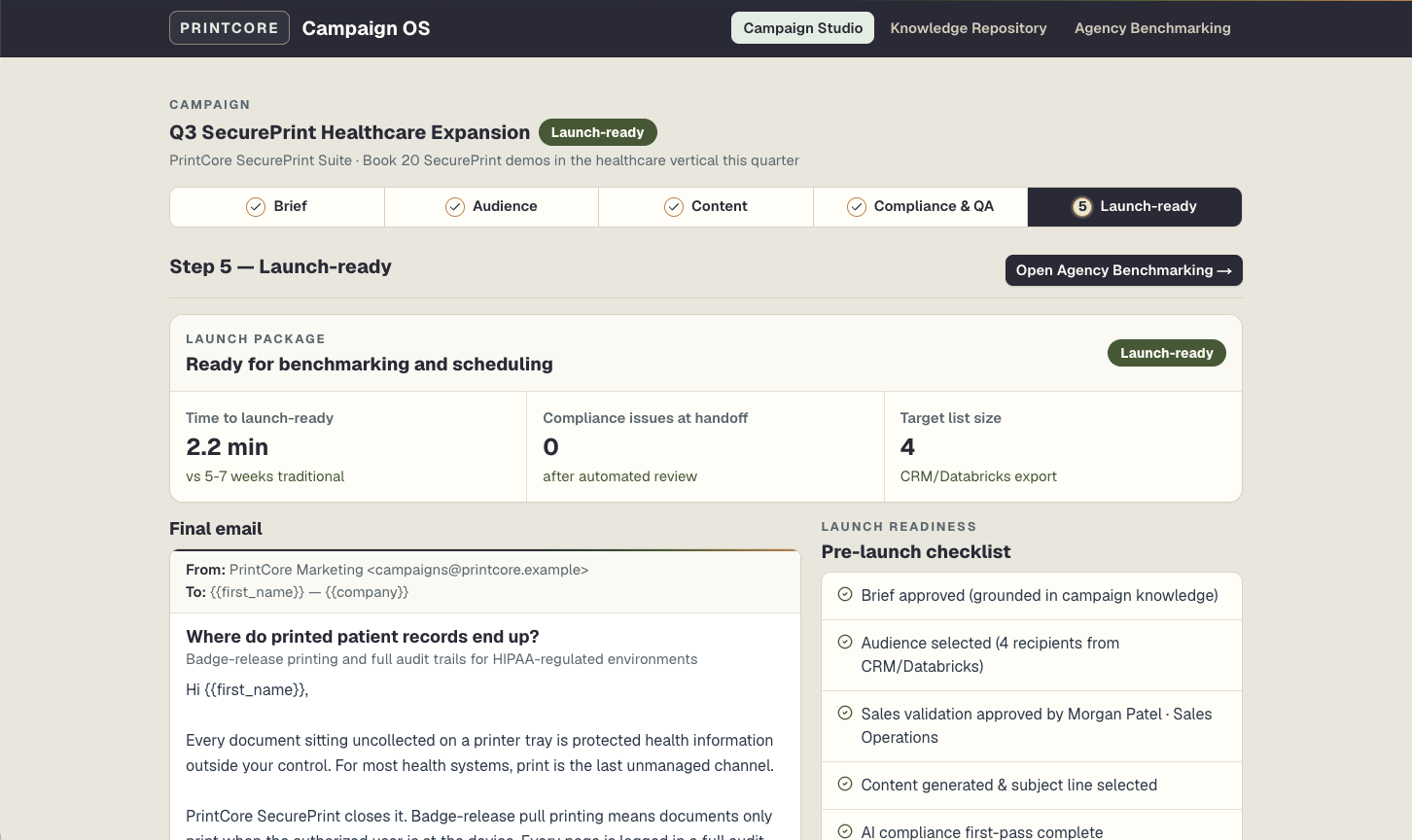
Slow, agency-dependent campaign execution, with hard-won knowledge lost between handoffs.
One operating system that runs a campaign from brief to launch, then learns from it.
A governed workflow plus a four-agent intelligence layer connecting feedback to the next campaign.
Campaign execution was slow, expensive, and difficult to improve over time.
A B2B printer company already had strong customer targeting through CRM and Databricks. The real bottleneck was downstream: turning strategy and customer data into approved, launch-ready materials without losing momentum to repeated agency handoffs and review loops.
Just as costly, nothing carried forward. What worked in one campaign was scattered across emails and agency files, so every new brief started from scratch instead of from evidence.
Traditional time from initial brief to final campaign rollout.
Recurring cost of routine campaign production work.
Learnings lived in emails and agency files, so each campaign started from scratch.
Where the process slows down
5–7 weeks from initial brief to rollout
Downstream production, repeated handoffs, and knowledge lost across emails and agency files.
Design one operating system for execution and continuous learning.
I structured PrintCore around two connected layers: an operating layer that moves a campaign from brief to launch, and an intelligence layer that turns each campaign's signals into recommendations for the next one.
Two layers, one feedback loop
Operational signals become reusable recommendations for the next campaign.
Move from brief to launch readiness in one connected workflow.
Campaign Studio runs the whole process as one connected workflow, making each stage's inputs, ownership, AI assistance, review status, and next action visible as work moves toward launch.
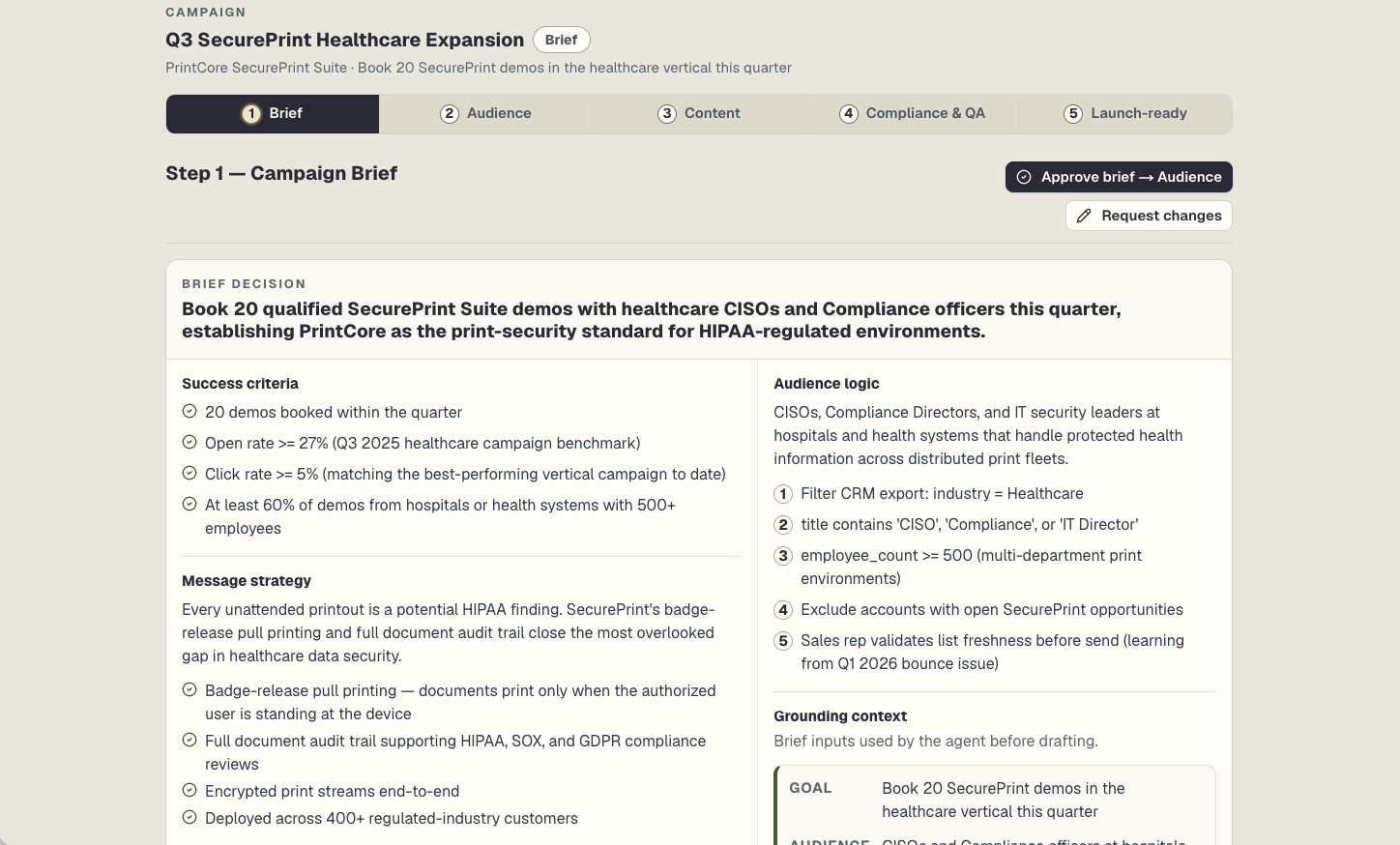
Brief
Ground the campaign before generation.
Connect the business goal, audience logic, success criteria, message strategy, and product proof before downstream work begins.
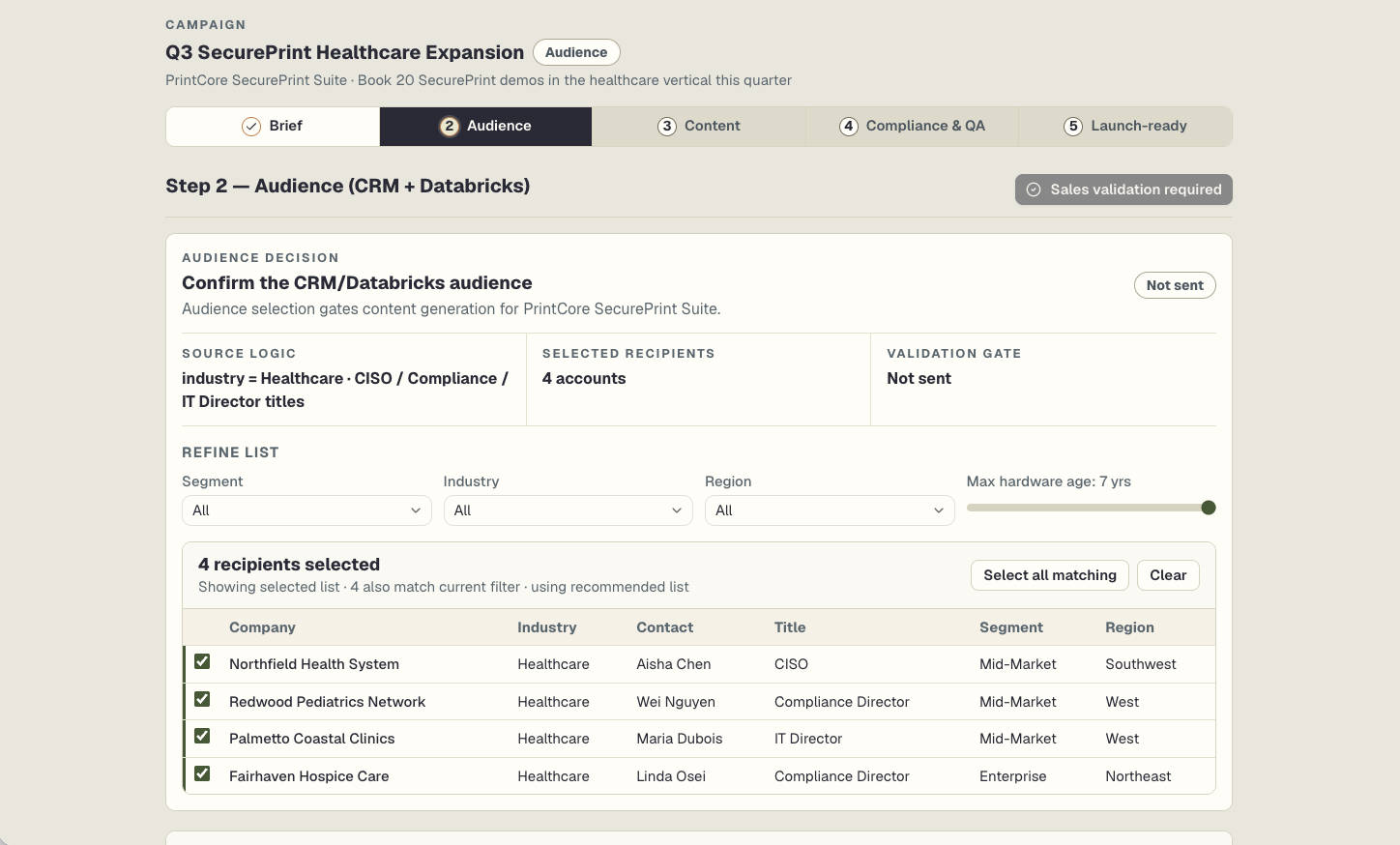
Audience
Validate the target list before content production.
Refine exported CRM and Databricks sample data and require sales confirmation before the team invests in content creation.
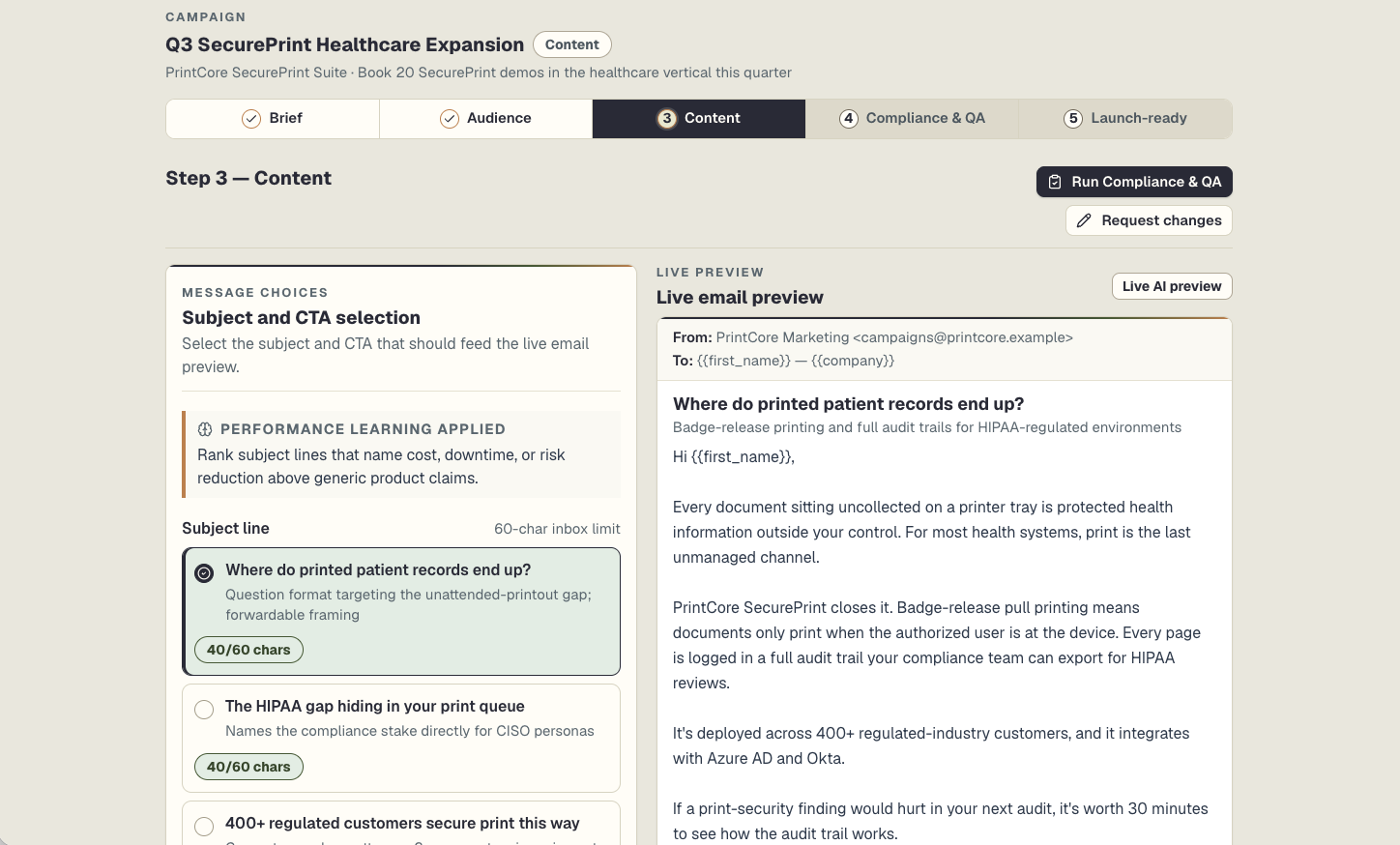
Content
Turn approved strategy into editable content.
Generate subject line, CTA, and email options from approved context while keeping every output reviewable and editable.
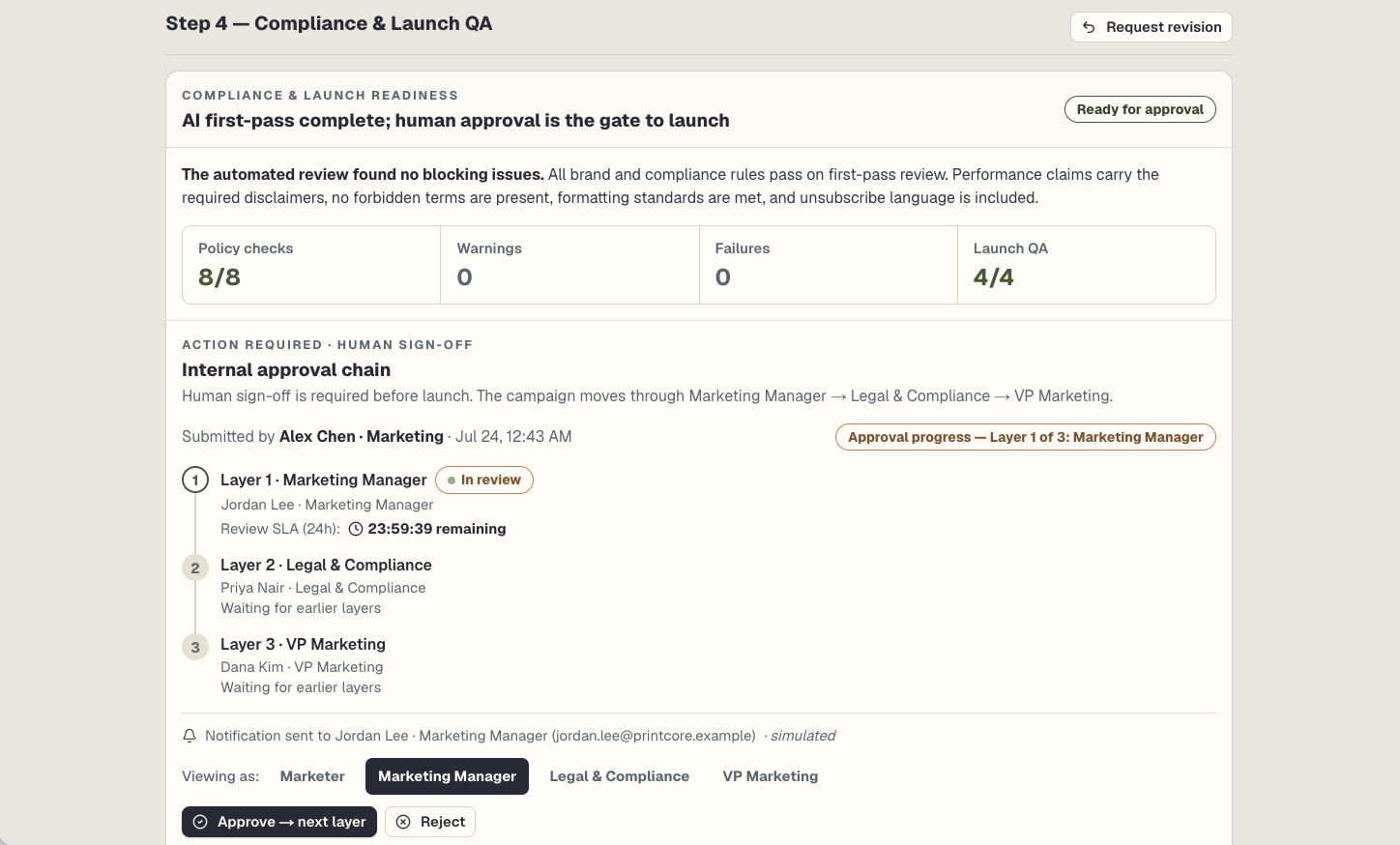
Compliance
Catch risk before stakeholder review loops.
Run first-pass policy and launch checks while keeping human approval as the final gate.
Ground AI in reusable knowledge, then learn from every campaign.
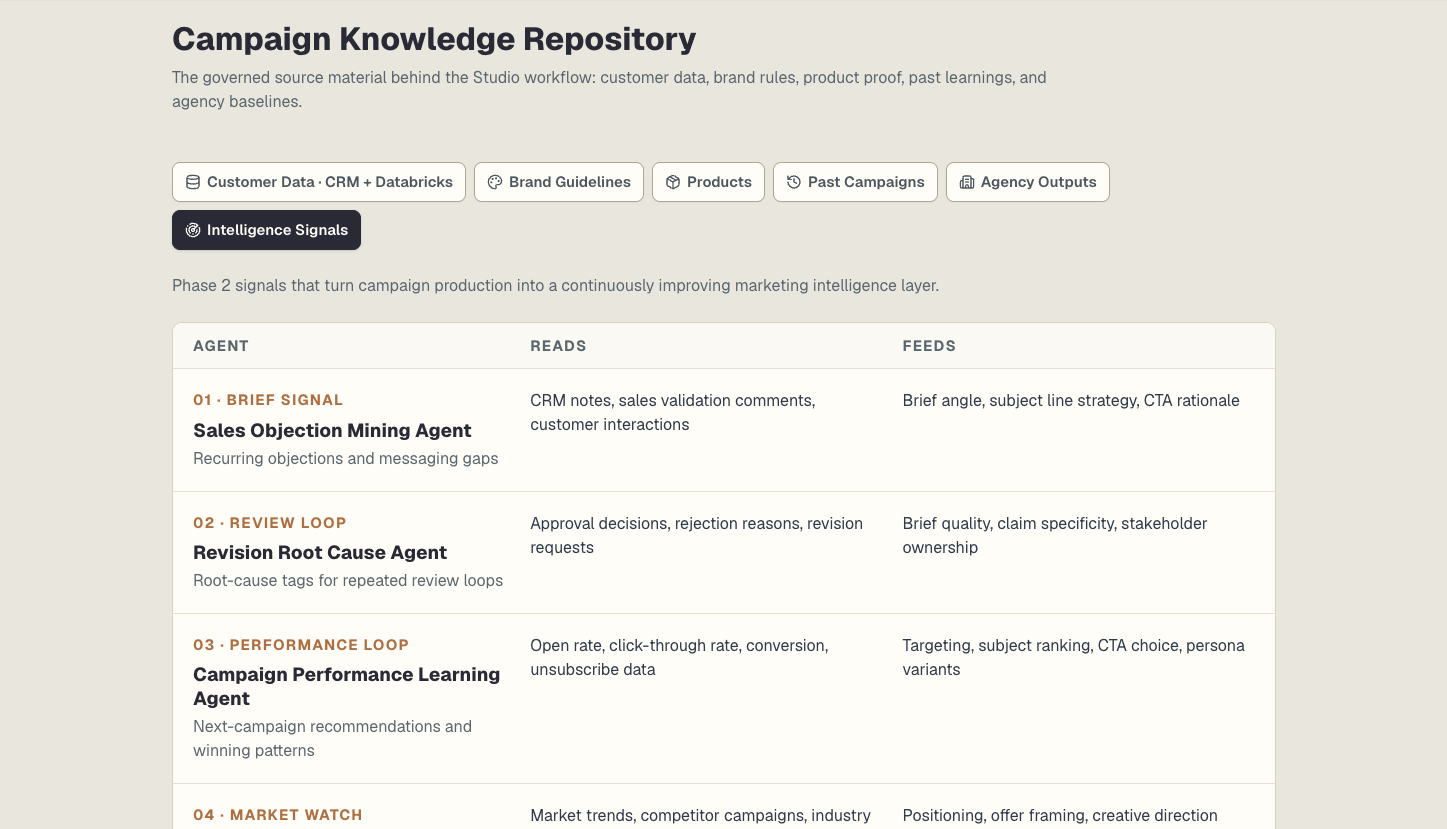
Knowledge Repository
Centralizes customer data, brand guidance, product proof, past campaigns, agency work, and intelligence signals so AI output is grounded in reusable organizational knowledge.
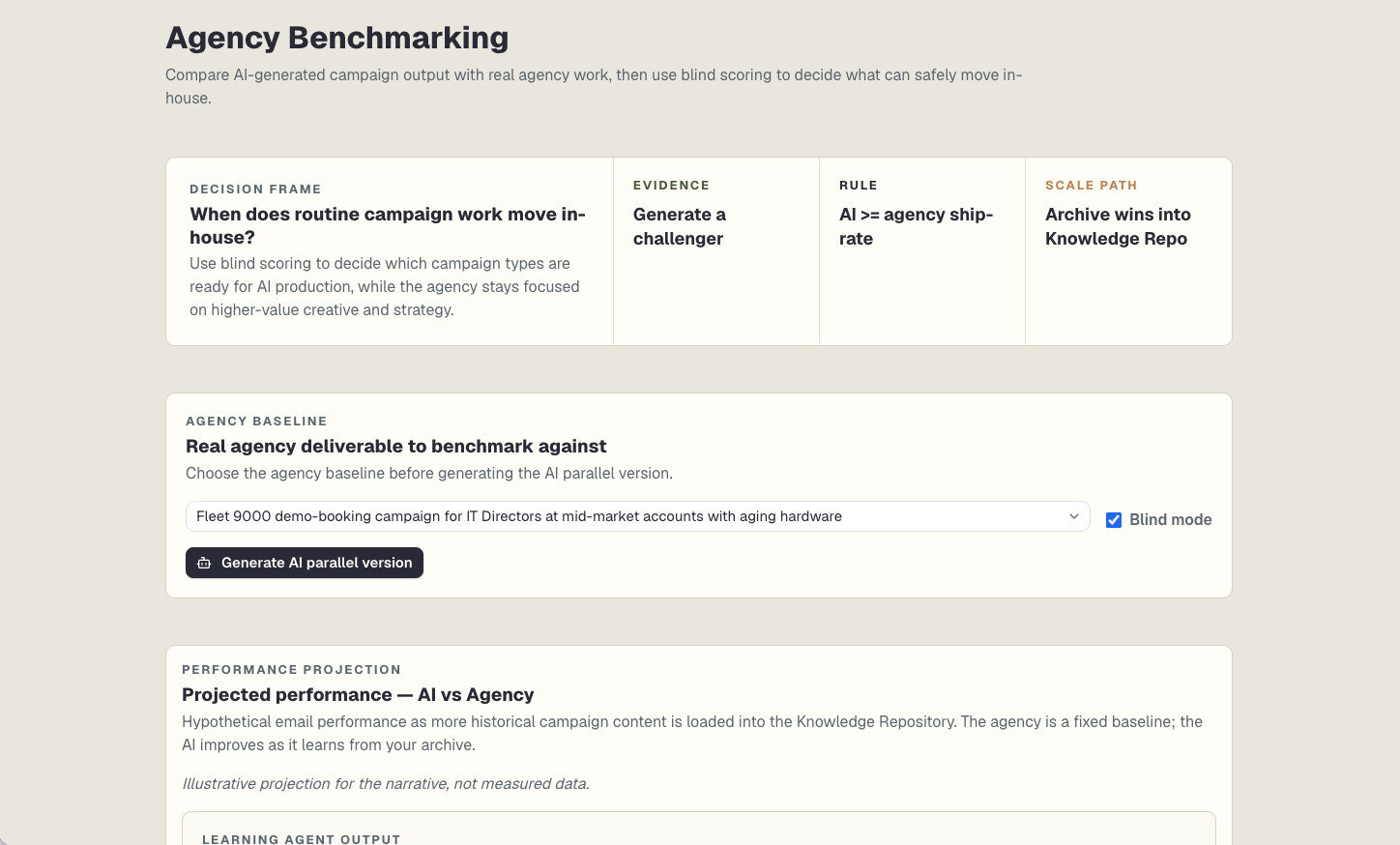
Agency Benchmarking
Compares AI and agency work through shared criteria and blind scoring before routine production moves in-house.
Every campaign feeds the next one.
Four agents read the signals each campaign produces and turn them into recommendations for the next brief.
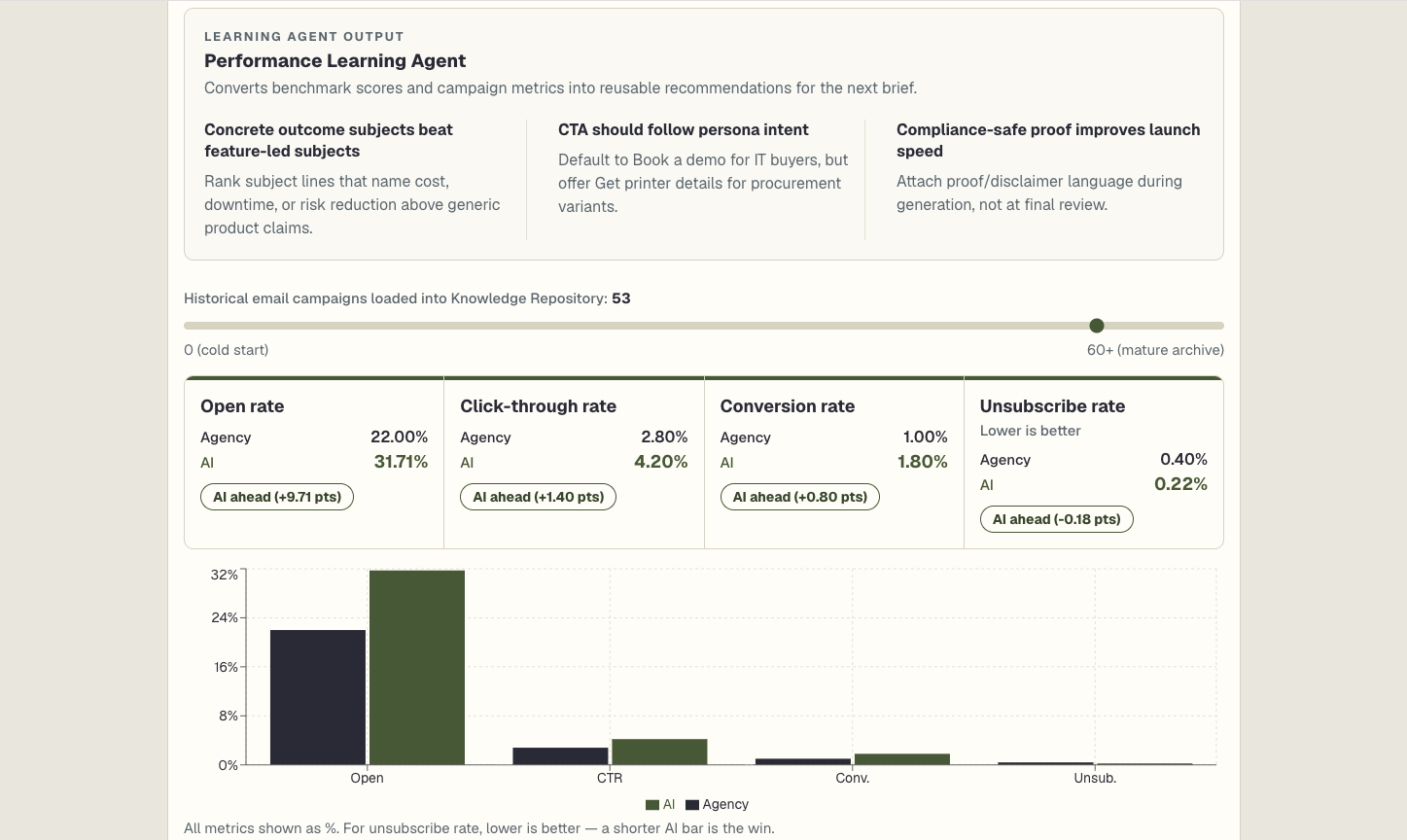
Reads CRM notes and sales validation comments to sharpen brief angle, subject strategy, and CTA rationale.
Reads approval and rejection decisions to improve brief quality, claim specificity, and stakeholder ownership.
Reads open, click, and conversion data to guide targeting, subject ranking, and CTA choice.
Reads market and competitor signals to shape positioning, offer framing, and creative direction.
A proposed path to faster execution and lower routine production costs.
The proposed operating model targets a shorter campaign cycle, lower routine agency spending, and earlier risk detection within one governed workflow.
What I learned
This project reinforced that a successful AI product is not defined by how much work it automates. It is defined by how clearly it establishes context, ownership, review, and trust.
The strongest solution was not an autonomous campaign generator. It was a governed operating system that connected creation, sales validation, human approval, agency comparison, and continuous learning.