Echo: Workflow Redesign
Optimizing Clinical Trial Matching Through Real-World Workflow Validation
Clinical trials depend on finding the right patients, a process called eligibility screening. Echo is a system that automates this matching using AI-generated eligibility criteria.
Echo 2.0 is a workflow-driven redesign of that system, informed by interviews with trial managers and clinical research coordinators. Rather than a visual refresh, it restructures how eligibility logic is defined, reviewed, and safely executed within a single interface.
Why Echo 2.0?
Interviews with professionals actively working on trial matching revealed that Echo 1.0 did not fully reflect real-world workflows.
Workflow continuity was missing
Coordinators had no clear path from defining eligibility criteria to producing and reviewing a matched patient list.
Connect the full workflow
Keep criteria definition, execution, and patient review within one reliable path.
Clinical criteria lacked specificity
Echo 1.0 could not express the level of eligibility detail that professionals needed for real clinical decisions.
Support clinical specificity
Allow more granular eligibility logic without making the interface harder to understand.
Support clinically specific eligibility logic while keeping the path from criteria definition to patient review easy to follow.
The Redesigned Workflow
Key Design Changes
Eligibility criteria were reorganized into two logical layers:
- Minimum Criteria (MC): baseline eligibility requirements
- Specific Criteria (SC): study-specific refinements
Each layer maintains explicit inclusion and exclusion logic. This structure mirrors how cohorts are progressively narrowed in real trial matching workflows.
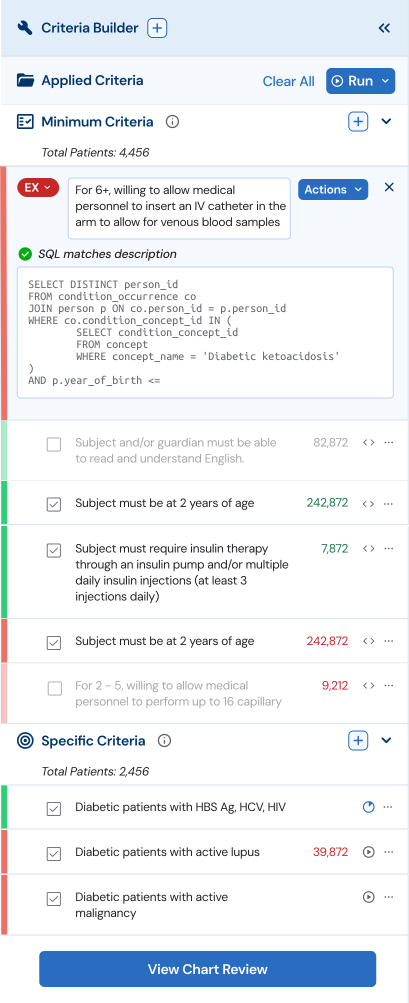
Each criteria row contains multiple states, actions, and outputs, making information density a core design challenge. To keep the interface scannable, primary information remains visible at all times while secondary actions are progressively disclosed.
Inclusion and exclusion logic is communicated through subtle color indicators with labels revealed only on hover. This lets users compare criteria, understand the impact, and take action without unnecessary cognitive load.

Designing for safe execution required treating saving, SQL conversion, and execution as distinct actions rather than a single step. Criteria cannot be executed unless the generated SQL matches the textual definition, ensuring logical consistency before any results are produced.
Execution status, progress, and outcomes are always visible, making system behavior explicit and traceable. This approach prioritizes transparency and trust in high-stakes clinical workflows.
Interaction Highlights
Inclusion and exclusion logic uses subtle color indicators with hover labels, letting coordinators scan criteria without reading every row in detail.
Counts stay hidden until criteria are fully executed, preventing premature decisions before the logic has been validated end-to-end.
Execution status appears directly on each criteria row, keeping system activity visible at the point of action rather than a separate status panel.
These patterns are currently being further developed and validated on the MarketScan dataset.
Why This Matters
- Workflow validation for high-stakes AI-assisted clinical decisions. Echo 2.0 was informed by interviews with practicing trial managers and clinical research coordinators. It treats saving, SQL conversion, and execution as distinct steps. AI-generated eligibility logic has to be validated before any patient counts are produced. This is a transparency-first pattern for high-stakes clinical decision support.
- Foundation for the IEEE VIS 2026 paper. The interaction patterns developed here (color-coded inclusion / exclusion, deferred patient counts, row-level execution progress, and the explicit save-convert-execute sequence) directly informed the visual analytics system documented in the IEEE VIS 2026 short paper "Echo: Visual Steering of AI-Assisted EHR Cohort Construction," where I serve as co-equal first author.
- Research context. Built within Dr. Hua Xu's group at the Yale School of Medicine, Department of Biomedical Informatics and Data Science, supporting biomedical AI research on AI-assisted clinical trial matching.
Key Takeaways
- Expert-facing systems demand different priorities than consumer products. Clarity and trust matter more than delight.
- Complexity is best made legible, not reduced. The goal was to expose eligibility logic transparently, not simplify it away.
- In high-stakes workflows, transparency and validation are core features. Every visible system state is a trust signal.